Friday, April 19, 2013

For "Chrissie"

I first heard the following story during my CHURCH SCHOOL BLUES years when a classmate told it in front of our English class as part of an oral presentation assignment.  Her harrowing tale of Mother-daughter love stayed with me long after I lost contact with my classmates, so much so that I later based a short story on it, which subsequently won a writing contest at INSIGHT MAGAZINE.  I did make an attempt to locate her and share my published version her story, but we didn't have the internet then, and I didn't find her.  Now through the wizardry of Facebook, we have reconnected, and at long last I get to tell her that this story is dedicated to her.

Here is the story as it appeared in INSIGHT MAGAZINE's 5-7-04 edition.


as told to Debra Wintsmith
Chrissie!” my father says softly, like he doesn’t want to scare me. But even half asleep, I can hear the fear in his voice.
I don’t want to wake up. I want to dream it’s yesterday morning, with the sun coming up bright over the mountain, and my mother waiting for me to slip into her bed for a before-school visit.
No matter how early I get up, my mother’s always awake. Awake waiting for me. She says she sleeps in the daytime while I’m at school. I curl up beside her under the electric blanket, and we talk about what I’m going to do that day. I can tell her stuff that would bore anyone else to tears, like every single word Tray Knight said to me in the hallway. My mother is my best friend.
I don’t tell her she’s my only friend, that because of her I don’t really fit in. I think that would hurt her. But mothers aren’t in style at our school. If you don’t have a major blowup with your mother every day, you just aren’t cool.

The popular girls at school hang around in the restroom between classes. They spread out their sweaters and books on the floor and sit with their backs against the wall, dissing their mothers.
Ashley rules the girls’ room. Yesterday when I walked in, she was saying, “My mother had hysterics! All because she went through my dresser and found my sequined nail polish! You’d think I’d done something illegal!”
Melissa sighed in sympathy. “I think my mother actually goes through my purse.” A giggle.
I don’t know what she thinks I’ve got in there! She’s such a snoop.”
Dawn suggested, “Maybe you ought to put something in there just for her to find!”
“Like what?” shrieked Melissa through gales of laughter. “You think I oughta put a—oh, hi, Christin.”
“How’s your mom?” Dawn ventured.
I stepped over the line of legs to the mirror and ran a brush through my hair. “I think she’s better this week.”
“Oh, good.” The others had gone quiet. They stayed that way until I left. It was their way of being kind.
“‘Bye!” they chorused as I stepped out the door.
The door shut and their voices burst out again.
I’m a teenager too, but I could never be like them. Their mothers are their pet peeve. I grab every minute I can with mine. Because I won’t have my mother much longer.

Daddy is shaking me gently, his voice close to my ear. “Chrissie, honey, you have to wake up.”
It’s dark. The clock says 2:30 a.m. My heart clenches like a fist. “Mom—”
“She’s taken a turn, Chrissie. The paramedics should be here any minute.”
“No! No!” I shut my mouth tight, but inside I’m screaming. No! Please, Jesus, not yet! Not tonight!
As I grab my coat, I think for a second that I screamed out loud, because the room is filled with noise. Then I recognize the wail of the siren.
I ride with Mother in the ambulance. She can’t talk to me because of the life-support equipment, but as the van lurches around the twisting hills toward town, her eyes never leave mine.
I don’t talk either. But our eyes say a million and one things to each other. Remember when we went up the Blue Ridge Parkway and we had to talk you out of hugging the bear? Remember when you made me a birthday cake and all the frosting slid off? Remember. Remember. Yes! Yes! Always and forever! Me too, chrissie, I remember everything you ever told me. Even the tiniest little detail, I remember. Always! Always!
Car lights play eerily against the black highway. Somewhere behind us, going much slower, Daddy follows in the car.
I cry—tears that fall somewhere inside of me and don’t get anything wet. Mother keeps looking into my eyes, and I know she sees me crying.
Remember what I told you about Jesus? That He will take care of us no matter what?
Yes, Mother, I remember. I remember how I prayed and prayed to Jesus to please make you well. You told me I shouldn ‘t. That you were ready to go when Jesus called
you.
But not now!

The driver curses. How dare he use words like that with my mother right here, fighting for her life! I look up and see past him. We’re on the open highway, and a pickup truck is racing us.
I hold my mother’s hand against my heart and watch the joyriders swinging toward us, crowding the rescue van. Our driver grips the wheel and holds stubbornly on course.
Mile after mile we’re neck-and-neck with the pickup. Even with the windows up and the siren going, I can hear the heavy pulsing of their radio.
I want to scream, “Stop it! You’re going to kill my mother!” But I say nothing. I don’t want Mother to know what’s happening.
I pray. Please, Lord, help us stay on the highway. Don’t let us die. Please, don’t let Mother die.
I open my eyes, not realizing I shut them. Mother’s eyes are looking into mine. Chrissie, Jesus knows what is best. I’m ready to go.
But I’m not ready for you to go! Not yet! Not now!
I don’t think I say it aloud, but I hear a voice speak quietly beside me. It’s one of the paramedics. “Happens all the time, miss. People gettin’ their thrills offa playin’ chicken with us.”
“Don’t they know it—it’s an emergency?”
“They don’ care.” His big hand squeezes my shoulder. “But Jerry there, he kin drive with the best. He’ll get us where we’re goin’.”
I’m praying again. Please, please help Jerry. Help Jerry drive.
I watch Jerry’s scarred hands clenching the steering wheel. They hold steady as he presses the accelerator to the floor. I see the first lights of town. The pickup edges back into its own lane and falls back at the city limits.

I feel a slight pressure on my hand. Mother is reassuring me that everything is OK. We glide into the emergency zone at the hospital. The glass doors fly open, and orderlies rush out.
As they lift Mother’s stretcher, I stare at Jerry’s face. It’s rough like his hands and his speech, but there are cheerful lines around his eyes and mouth.
“Thanks, Jerry,” I say.
He nods. “Hope your mom does OK.”
I stand under the clear night sky, waiting for Daddy so we can go inside together. An hour ago I would have been running after the stretcher. They would have had to force me to stay outside in the waiting area. But for some reason I feel peace now. Maybe it’s just relief that we weren’t run off the road.
But no, it’s more. I realize that now, for the first time, I’ve released my mother into God’s hands. Your will be done.
If I lose my mother tonight, I know I’ll never be able to replace her. But she will leave something I can take with me the rest of my life. Remember! Yes, remember.
In the short time we’ve been given, we’ve forged a powerful love. Other girls battle their mothers. It will take them years to forgive, to accept, and to love each other. Mother and I have found a calm.
“Chrissie, are you OK?” Daddy comes toward me out of the dark parking lot.
I slip my arm around his waist. “Yes, I’m OK,” I say, and it’s the truth.

INSIGHT  MAGAZINE'S NOTE AT THE END OF THE STORY: This story won first prize in the general short story category of our 1993 writing contest. This incident happened to a high school dassmate, who told Debra, “God let me be with my mother another whole year after that night.”

Friday, April 5, 2013

Exonerating Jadesy Horn


In CHURCH SCHOOL BLUES, a character I named Jadesy Horn tries to befriend me and I am unable to respond to her overtures because by that time I have been bullied into a chain link fence of silence that I can't break out of.  About a month later, I decide that Jadesy wasn't sincere about wanting to be friends because she invited everyone in our class to her birthday party except me.  In the narrative I describe how each desk, save one, had a crisp white invitation envelope placed upon it.  It is a classic episode in the life of a kid who doesn't fit in.

Through the next six school years, I viewed Jadesy Horn skeptically because I believed that she had excluded me, and only me, from her birthday party in the 7th grade.  And we never became friends.

But while writing the story all these years later, something occurred to me for the first time.  I realized that I had blamed Jadesy Horn for something she may not have done.  For one thing, such a mean act didn't fit into the rest of Jadesy's personality in all the time I knew her.  This isn't something that I could have rationalized at the age of 11.  Such is the luxury of time passing.

Now I wondered, how do I know that Jadesy didn't place an invitation on my desk?  How do I know that it wasn't snatched away by one of the other kids whose personalities did fit the crime?  I don't know it.  I assumed, and it was a reasonable assumption at the time because so many people in my world at the time were cruel.  But I may have been wrong about Jadesy Horn.

I almost feel as though I owe her an apology for sticking with the perspective that I had at the time.  But CHURCH SCHOOL BLUES isn't Jadesy's story.  It is mine, with the feelings and perceptions that I had then.  Right or wrong.

It is moments like this that make writing from real life a unique experience.  The author must constantly decide whether to write the story as it was lived or to adjust it in light of future perspective.  In order to maintain the integrity of the story, I believe that the author who writes from life should avoid as much as possible the intrusion of the older, wiser self.

But I still feel a twinge of guilt about Jadesy Horn.


Wednesday, April 3, 2013

Never Thought I'd See You Again


I wrote FIREFLIES and CHURCH SCHOOL BLUES with the insulation of decades between me and the events described. The colorful characters described in the books left my life at the same time that the narratives end, so it is a very odd feeling that suddenly people out of both books are resurfacing in my world.  I changed the names, of course.  There is nothing in the books that resembles slander, and I don't believe I wrote cruelly even about those who did me cruelly, but I have thought of them for so long as story characters that it is a bit unsettling to be reminded that they are and were real people.

I have always viewed life and people as stories.  It is part of how I survived some difficult years.  To see things in terms of plot, conflict and resolution instead of whining about the unfairness of life gives me an advantage as a writer.  What might have destroyed another person has made me richer.  Oh, the stories I can tell!  
  
But back to the reappearance of the characters from my books.  Might one say "YIKES!" ?  

This is the thing about writing from real life.  Perspective varies.  This was emphatically brought home to me when interviewing family members for PRECIOUS JEWELS, A SDA FAMILY SAGA.  People experience things differently depending on their position in the story, or upon the position of the person who passed the story down to them.  I compromised when recreating some of the incidents, basing what I think happened upon other supporting evidence from the time, reconciling disagreeing witnesses into something that made sense and was true to the essence of the characters involved.

But the stories in which I write from personal experience are different.  The power of the narratives is fueled by the intensity of which the narrator experiences them.  In FIREFLIES, I experienced intensely the loss of a friendship.  Writing that narrative, I realized that the child who impacted me so deeply  had no idea what was at stake for me when she eagerly embraced new friendships and moved forward without me, while I stubbornly refused to change, haunting our old secret places alone.  If she told the story, she would tell it differently, and I would probably be a minor character.  But FIREFLIES is my story, my perspective, and I imagine she will be quite startled how I felt if she reads it.

The same for CHURCH SCHOOL BLUES, whose characters are also starting to reappear in my world.  I wrote it as I lived it, but it may not be as they lived it, walking in their shoes, living their own blues.

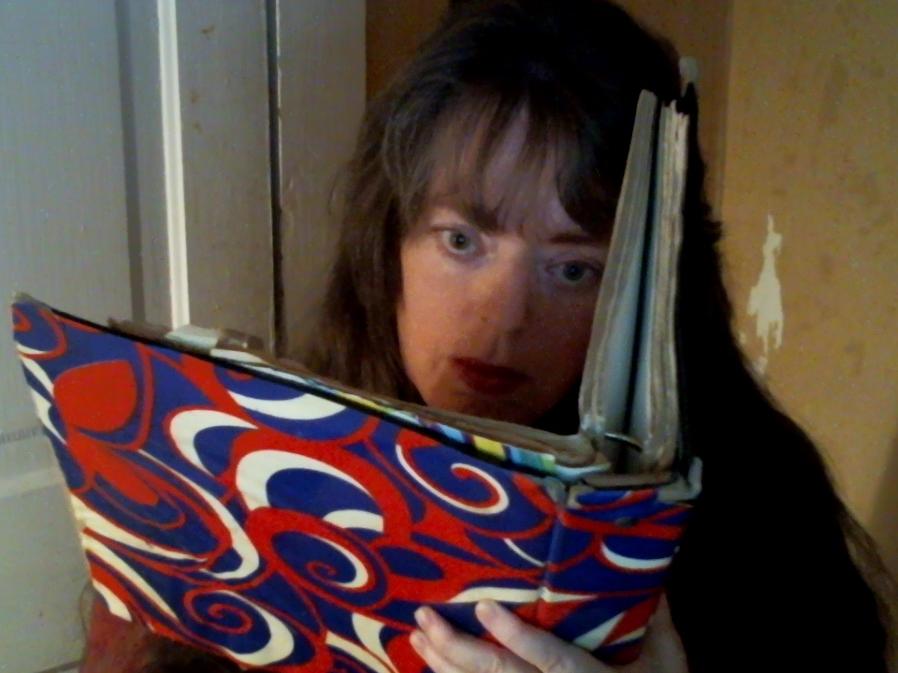
Pictured: If you knew me then, the picture above is probably what you saw of me.  The notebook is the same one that I carried in the CHURCH SCHOOL BLUES years, scribbling Gothic novels while pretending to take notes in class.  

Friday, January 4, 2013

Why Did You Let It Happen?


She had just finished reading Church School Blues, and she had a question.

"Why did you let all this happen to you?"

"If it had been me," she added, "I would have set them straight right away!"

If they were climbing over the walls of the toilet stall, staring down at her, why, she would have brought a squirt gun to school and it might not be water she squirted up at them, either!

The answer to that question is complex.  It is a question that bothered me for years.  Why did I allow them to bully me?

One problem with that question is that it implies blame upon the bullied instead of on the bullies.  And yet, I'm not going to take the easy out and say that her question isn't valid.  The fact is that the few times I was able to stand up to them, they weren't very tough at all.  My bullies would have been ridiculously easy to have set in their place had I been up to the task.

Had I been up to the task.

But I wasn't up to the task, and this is where a term I ran across recently makes things more clear. Some people avoid the term "bullying."  They use, instead, "peer abuse."

Understanding bullying as abuse allows us to consider the dynamics that occur in other types of abusive relationships.  In abusive relationships, there is an unequal distribution of power, for whatever reason.  In my case, the obvious inequality is that there were more of them than there were of me.  They were louder, more confident, and they had the support of the other students and the teachers.  There were other inequalities that placed more power on their side, such as my own personality which was introspective and creative.

But it was the abusive factor that froze me in place and struck me down again and again.  When one is a abused, the boundaries shift and points of reference are skewed.  One is no longer certain where one stands, and one becomes unsure if what is being done is, indeed, abuse.  Words are like fists, and so one staggers about just as stunned as if one has been punched in the face.  It is a head blow.

Disoriented from the blows, one begins to question one's own perception of reality.  "Is this really happening or am I over-reacting?  And if it's happening, is it because I am failure as a human being?"  The bullies and bad teachers, and even well-meaning parents are quick to assure one that it is indeed a case of exaggeration and failure to try hard enough.

Add in immaturity to the quotient and you have a kid who is twisting in the wind with no life history for reference and comparison.

I am fairly certain that if a group of faces appeared over the bathroom stall today, that I'd be as capable as my questioning reader of shoving something into those faces, but I now have decades of experience that helps me to define what the boundaries are.  I understand now that even if I really am a misfit, even if I am ugly, even I am any number of other negative descriptions, that nobody has the right to violate personal boundaries that make me uncomfortable.

But one doesn't have that wisdom when the boundaries are blurred and the points of reference are unrecognizable.  Then it is a matter of endurance, and if you can just endure until you can find a point of reference that makes sense, until you can begin to make sense of the whole dynamic, then you become a survivor.  But for most of us, that comes later.

It takes years.

------------
The term "Peer Abuse" is credited to Elizabeth Bennett.

Monday, December 3, 2012

Forgiveness Comes Later


I came across an article on The Christian Post website which got my dander up a bit.  It gave a synopsis of ideas about bullying from author Wendy Cooper Starr.  The article made several points.  The first one, I agree with -- I don't think anti-bullying policies are the path to reducing the amount of verbal bullying in schools.  My agreement with the article ended  at this quote:

“Children need to learn bullies are being controlled by Satan. They need to learn forgiveness. They need to learn how to do good things for bullies.” 

I was a Christian child bullied in Christian schools by Christians.  I don't think my bullies were controlled by Satan.  I think they were bored, spoiled kids who, despite the Christian surroundings, had not been trained to be kind to others.

It's not going to stop the bullying to "do nice things" for the bullies.  The doing-nice-things approach can work in conflicts between peers where there is a basic equality and the problem is a personality conflict or a quarrel.  I don't consider those situations to be bullying.  I define bullying as a concentrated, ongoing harassment where there isn't equality -- due to shyness, size, vulnerability, or a child who is outnumbered, a child who is isolated by peers.  A kid who is bullied is so beaten down, mentally or physically, that it is a tremendous accomplishment just to function from day to day without cracking up.  A bully is an abuser.  Expecting an emotionally battered child to try to "do nice things" for their abusers is a good way to lock them into the victim mentality for life. 

It is premature to talk forgiveness while a child is being bullied.  Survival is the issue of the moment. God and the Bible can help the child endure, but forgiveness is an issue you deal with later while dealing with the long-term effects of bullying, as you piece back together your shattered sense of self and figure out how you can possibly fit into this world.  And the biggest challenge may be to forgive yourself for being the sort of kid whom others would bully.  Self esteem isn't something Christians seem comfortable with teaching, but it is there in the Bible.  When you love your neighbor as yourself, that means that it is right and proper to love yourself.  And loving self will be the most challenging lesson a bullied child will have to learn.

Tuesday, November 27, 2012

Church School Bullying

This candid photo shows the isolation I felt in academy. I'm the kid standing alone in the doorway, trying to figure out what do do with my hands and arms, nothing feeling natural. I've rooted myself. against the door frame, unwilling to commit either to coming into the room or remaining without.
I've got a bad case of the Church School Blues.

Is CHURCH SCHOOL BLUES the only book around that tells the story of bullying in a religious school setting?  In my search, I am finding many books on bullying in general, and a few documentaries about the subject of bullying in churches and religious schools, but other than that, BLUES seems to stand alone.

It's not the first time I've stood alone.  

So perhaps I shouldn't be surprised that BLUES is alone on the shelf.

Although I wonder.

Are religious schools still in denial that bad things can happen there?

Bullying in a secular setting is one thing.

Bullying in a religious setting is another.  Why?  Because it isn't just a matter of not fitting in with a social group.  It is a matter of fitting in with one's religious group.  If one doesn't experience belonging there, eventually, one leaves to find some place where one can fit in.

That's what I did.


Thursday, November 22, 2012

Thanksgiving with CHURCH SCHOOL BLUES


Thanksgiving excerpt from Church School Blues, Chapter Four

Meanwhile, Daddy has been working steadily at his new job as a diesel mechanic. Even so, the money isn't coming in as quickly as it is going out. We were so tight for a while this past summer, we didn't have anything to eat except spaghetti. Fortunately I love spaghetti, but even I was glad when we could add something else to our diet.
I wish I could sell enough pop bottles to pay for my Christian education since that always comes up as being a drain on our household resources. But it isn't just the monthly tuition that is a burden. My school is expecting my parents to shell out extra money for "activities." Like the Thanksgiving play.
Elder Hargis says everybody has to be in it, no excuses. Not that I get a part in the play. I'm just supposed to get an Indian costume and walk around being an Indian, sitting in a tepee and string popcorn. And that means I have to have an Indian costume.
Well, I don't put things off. I face them right away, so I brace myself and give Mother the news that I have to have a stupid costume.
“Oh, honey,” Mother says (just like I knew she would). “We can't afford it!”
 “Just get me some feathers or something. If I stay in the very back, nobody can see what I’m wearing.”
That makes Mother feel guilty and she apologizes about not giving me more in life—as if I ask for more of my own free will. "I don't care how it looks," I assure her, "as long as it gets past Elder Hargis."
Remember Mother's Ingenious Compromises? Next thing I know, she has done a loo-loo of an Ingenious Compromise. When I come home from school the next day, I find Mother fiddling with two burlap sacks on the kitchen table. I love gunny sacks because they remind me of Grandpa's sheds back home, all grainy smelling and rough to the touch. Not wanting another go-around about What I Do and Could Not Possibly Remember, I don't mention this fact to Mother.
"We can't afford to buy a real costume for you," says Mother, "but I think I can make you one out of these."
Unlike many Adventist mothers, my mother doesn't sew as a rule, but I don't have the slightest doubt that she can make something if she says she can. So I calmly go off and do my homework, until about an hour later she calls me to come take a look.
Can you spell flabbergasted?
This has got to be her top Ingenious Compromise ever!
My mother has taken an old gunny sack and made it into something that is not only beautiful, but looks as natural as if it was made out of deerskin—even to the fringe which she has created by pulling the strings at the openings of the sacks—around the hole that is the neckline, the holes that are the sleeves, and the bottom of the skirt, all fringed.
"I found some plastic beads on sale from Halloween," she says. "Look here." She turns the blouse around, and it has the most lovely decorations sewn around the neck!
"It's gorgeous!" says I.
"Try it on so we can see if it fits." She makes a tuck around the waist and it's a perfect fit. "Indians often went barefoot, so I decided you'll be fine without moccasins. We'll dress you warm till we get to the school, and then you can go barefoot on all that carpet. And, guess what else I found on clearance?"
At this point I am willing to believe almost anything. Mother reaches into a store bag and pulls out a wig with long black hair. Crazy as it may sound, I'm almost looking forward to the play now!

Whether I'm looking forward to it or not, the night of the play is upon us and my transformation is complete. Mother braids the wig and wraps a band around it, topping it with a mockingbird feather I found out back. Now for the really dark make-up. Whoa! I didn't know I had inherited Mother's cheekbones, but I sure look like an Indian tonight. And that stoic thing I've been doing with my face lately fits right in. Only the green eyes give me away—and, oops, I can't help it, I'm grinning ear to ear and that ruins the whole effect.
"Don't smile," says Mother. Well, not smiling won't be difficult once I get to school.
School looks strange at night, and the presence of so many parents tones down the Dodos. They seem to be on their best behavior. They're staring at me, though. I can feel everyone staring at me as I stealth in on bare feet.
"Wow," says Fiona. "You look like a real Indian."
Fiona sure doesn't. She's wearing a full costume that looks super expensive, but it's obviously plastic, and the feathers are dyed chicken feathers. I walk among my staring classmates, assessing each one, and they all fall short of my mother's magic touch. I feel my back going straighter and my chin tilting proudly, and none of the corners are itching. I wish I could wear this costume every day. I could be myself again if I could always come to school in bare feet with my hair hanging long, with feathers.
I can't believe how polite the Dodos are. It's almost scary that several of them say how cool I look. Jill looks startled when she sees me, but she doesn't say a word about my appearance. She gets funny like that sometimes. Part of the time, she's about my only friend, and part of the time she's laughing at me along with the Dodos. I think I understand her, though. She really likes me, but can't stand being unpopular, so there are times she'll turn against me when she thinks it might help her status.
Then sometimes, when the real me shines through like it is tonight, she gets an expression like she is afraid that I'm going to keep on shining and rise up in the world. And when that happens, she thinks I'll leave her behind with the Solos. But I wouldn't do that to a friend, honest.
Over yonder, trying to disappear into the wall, is Belinda. She has one of the plastic costumes, and no one has tried to disguise her blonde hair. It is plastered close to her head and her bangs are wet. Her nerves are probably in high gear. If I've been dreading tonight, it's nothing compared to what Belinda is going through.
As we line up on the stage to sing about the first Thanksgiving, I make sure I am standing next to her. She is shaking all over with stage fright even though we are in the back row. I reach out and take her hand. It is sopping wet. By the time the singing is over, she is finally calm enough to sit beside me and string popcorn by the paper teepee.
We string and string as the people with real parts dominate the stage, and I wonder if they are listening to the story they are telling. It is a story about people who were very different from each other, and they had this meal and became friends. It's a nice story, but it's not the whole story. I've watched Bonanza and Daniel Boone on television, so I know how things went later on with the Native Americans and the settlers. They didn't stay friends, but people still tell the story of Thanksgiving as if that one dinner is important. And it must be important or we wouldn't still tell it every year, would we?
I guess it's kind of like the Dodos and me tonight—me walking proud and them being nice. For a short time, we're just people without castes or races or other silly labels. That's important because it means it's possible for people to get past all those prejudices for the space of a meal or a play—and if we can do it for an hour or two, maybe we could make it last longer.
But don't think I've been fooled by the Thanksgiving story. I know that when school starts up again, we'll be back in the wild frontier.